

Thyroid Nodules: What They Mean, Why They Form, and When They Matter
Understanding Thyroid Nodules

Anatomy of thyroid picture

Anatomy of thyroid gland

more thyroid images
Thyroid nodules are extremely common, yet they often cause considerable worry when they are discovered. Many people are told they have a thyroid nodule after a routine scan or ultrasound and are left wondering what it means for their health.
A thyroid nodule is simply a lump or growth within the thyroid gland, which sits at the base of the neck just below the Adam’s apple. These nodules may be solid, fluid-filled, or a mixture of both.
While the discovery of a lump can sound alarming, the reassuring news is that most thyroid nodules are benign (non-cancerous) and many never cause problems.
Research suggests that up to half of adults may develop at least one thyroid nodule during their lifetime, especially as they get older. In fact, many people have nodules without ever knowing it, as they often produce no symptoms and are only detected during imaging studies such as ultrasound scans.
Understanding what thyroid nodules are, why they form, and how they are investigated can help reduce anxiety and allow people to make informed decisions about their health.
Why Thyroid Nodules Develop
Thyroid nodules usually develop gradually over time due to changes in thyroid tissue. In many cases, they are the result of long-term influences affecting how the thyroid gland functions and repairs itself.
Several factors can contribute to nodule formation.
Nutrient Imbalances
The thyroid gland depends on a range of nutrients to produce hormones and maintain healthy tissue.
Some of the most important include:
iodine
selenium
zinc
iron
vitamin A
vitamin D
the amino acid tyrosine
If these nutrients are lacking or out of balance, the thyroid may struggle to regulate hormone production effectively. Over time, this can lead to irregular growth patterns in thyroid tissue, which may appear as nodules.
Chronic Thyroid Stimulation
The thyroid is regulated by a hormone called TSH (thyroid-stimulating hormone), produced by the pituitary gland in the brain.
If thyroid hormone production begins to decline, the body may increase TSH in an attempt to stimulate the thyroid to work harder. Over time, this constant stimulation can encourage areas of the thyroid tissue to grow more than others, eventually forming nodules.
Autoimmune Thyroid Conditions
Autoimmune conditions can also affect the structure of the thyroid gland.
In disorders such as Hashimoto’s thyroiditis, the immune system mistakenly attacks thyroid tissue. This chronic inflammation can create irregular areas within the gland that may appear as nodules or “pseudonodules” on imaging.
Another autoimmune condition affecting the thyroid is Graves’ disease, which causes excessive thyroid hormone production and can sometimes be associated with nodular changes.
Hormonal Influences
Thyroid nodules are significantly more common in women than men, suggesting that hormones may play a role.
Estrogen is believed to influence thyroid tissue growth, which may explain why nodules are often detected during:
perimenopause
menopause
pregnancy
times of hormonal fluctuation
Environmental and Lifestyle Factors
Long-term exposure to environmental stressors may also contribute to thyroid changes.
Examples include:
radiation exposure
endocrine-disrupting chemicals
chronic stress
ongoing inflammation
smoking
While these factors do not guarantee that nodules will form, they may influence how thyroid tissue behaves over time.
The Different Types of Thyroid Nodules
Not all thyroid nodules are the same. Doctors often classify nodules based on their appearance on ultrasound and their cellular structure.
Understanding the type of nodule present helps guide decisions about monitoring and treatment.
Colloid Nodules

Colloid nodules ultrasound
They develop when thyroid tissue grows and accumulates large amounts of colloid, the protein-rich material used by the thyroid to produce hormones.
Colloid nodules are usually benign and rarely become cancerous. They may occur as a single nodule or as part of a multinodular goitre, where several nodules are present within the gland.
These nodules may remain stable for many years or grow slowly over time.
Thyroid Cysts

Ultrasound of inflammatory thryoid nodules
Thyroid cysts are nodules that contain fluid rather than solid tissue.
They can be:
entirely fluid-filled
partially cystic with both fluid and solid components
Pure thyroid cysts are typically benign and may arise when older nodules break down or when fluid accumulates within the gland.
Some cysts fluctuate in size and may occasionally cause a feeling of pressure in the neck.
Thyroid Adenomas

Thyroid adenoma picture
A thyroid adenoma is a benign tumour made from thyroid tissue.
These nodules are usually encapsulated, meaning they are surrounded by a thin fibrous capsule separating them from normal thyroid tissue.
Some adenomas are “non-functioning,” meaning they do not produce hormones. Others may become autonomous or “hot nodules,” producing thyroid hormone independently of the body’s normal regulatory systems.
In such cases, they can contribute to mild hyperthyroidism.
Inflammatory Nodules
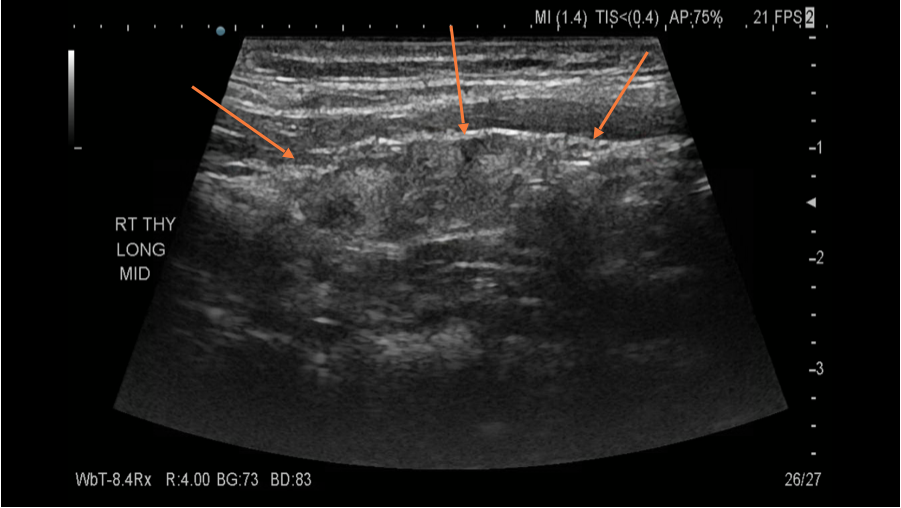
Inflammatory thyroid nodules ultrasound
In autoimmune thyroid conditions, inflammation can create irregular areas within the thyroid that resemble nodules.
These are sometimes referred to as pseudonodules, as they are not true growths but rather areas of inflamed tissue.
They are commonly seen in people with Hashimoto’s thyroiditis, particularly when the thyroid gland has become enlarged or structurally uneven.
Malignant Thyroid Nodules
Fortunately, thyroid cancers tend to grow slowly and often have an excellent prognosis when detected early.
The most common form is Papillary thyroid carcinoma, which accounts for around 80–85% of thyroid cancers.
Doctors use ultrasound features and sometimes biopsy testing to determine whether a nodule might be suspicious.
Thyroid Nodules With Normal Blood Tests
One of the most confusing aspects of thyroid nodules is that blood tests may appear completely normal.
Many people are told their:
TSH
Free T4
Free T3
are within the normal range, yet imaging shows nodules present within the gland.
This happens because blood tests measure hormone levels, not thyroid structure.
A person can have structural changes in the thyroid without hormone production being significantly affected.
This is why ultrasound imaging plays such an important role in assessing thyroid health.
Symptoms Thyroid Nodules May Cause
Many nodules cause no symptoms at all.
However, some people may experience:
a visible lump in the neck
a sensation of fullness or pressure in the throat
difficulty swallowing
hoarseness or voice changes
discomfort when lying down
Large nodules may occasionally press against nearby structures such as the windpipe or oesophagus.
How Thyroid Nodules Are Investigated
Several tests are used to assess thyroid nodules and determine whether they require monitoring or treatment.
Thyroid Ultrasound
Ultrasound is the primary imaging tool used to evaluate thyroid nodules.
It allows clinicians to assess:
nodule size
shape
internal structure
blood flow
suspicious features
Ultrasound can also determine whether nodules are:
solid
cystic
mixed
This information helps guide decisions about monitoring or further testing.
Fine Needle Aspiration Biopsy (FNA)
If a nodule appears suspicious or exceeds a certain size, doctors may recommend a fine needle aspiration biopsy.
During this procedure, a very thin needle is used to remove a small sample of cells from the nodule.
These cells are examined under a microscope to determine whether they are benign or malignant.
Most biopsy results confirm that nodules are benign.
Thyroid Blood Tests
Blood tests provide information about thyroid hormone production and immune activity.
Common tests include:
TSH
Free T4
Free T3
thyroid antibodies
In some cases, nutrient testing may also be useful to evaluate factors that influence thyroid function.
Monitoring Thyroid Nodules
Many thyroid nodules do not require treatment and are simply monitored over time.
Doctors may recommend follow-up ultrasounds every:
6 months
12 months
or longer intervals depending on risk factors
Monitoring allows clinicians to ensure that nodules remain stable and do not develop suspicious features.
Supporting Thyroid Health Naturally
While nodules themselves may not always require treatment, supporting overall thyroid health can be beneficial.
Strategies may include:
Optimising Key Nutrients
Ensuring adequate levels of nutrients involved in thyroid hormone production and tissue health, including:
iodine (when appropriate)
selenium
zinc
iron
vitamin D
Addressing Inflammation
Reducing chronic inflammation in the body may help support thyroid tissue health.
This can involve:
improving gut health
managing autoimmune activity
reducing oxidative stress
supporting the immune system
Monitoring Hormonal Balance
Hormonal changes, particularly in women, can influence thyroid health. Supporting overall endocrine balance may help maintain healthy thyroid function.
When to Seek Medical Review
Although most thyroid nodules are benign, certain symptoms should be investigated promptly.
Medical review is recommended if:
a nodule grows rapidly
persistent hoarseness develops
swallowing becomes difficult
lymph nodes enlarge in the neck
new symptoms appear
These signs do not necessarily indicate cancer but should always be assessed by a healthcare professional.
The Bigger Picture of Thyroid Health
For many people, discovering a thyroid nodule raises concerns and unanswered questions.
It is important to remember that most thyroid nodules are harmless and can be monitored safely.
However, nodules can sometimes provide clues about broader influences affecting thyroid health, including nutrient status, immune activity, and hormonal balance.
Understanding the factors that support healthy thyroid function can help individuals make informed choices about their wellbeing.